Executive Summary
For The Reader In A Hurry
The problem: We are living in what I call the Pretend Era — a period in which the gap between what institutions claim to do and what they actually do has become so wide that the entire population can see the gap, but no one can close it. This is not a conspiracy. It is a behavioral phenomenon called pluralistic ignorance: the condition in which most people privately disagree with the public consensus but assume they are in the minority, so they stay silent. The silence is the disease. It is also the opening.
The diagnosis: The binding constraint on political, social, and institutional progress is not intelligence, resources, or policy design. It is intangible psychological infrastructure: trust, legitimacy, belonging, and shared reality. When this infrastructure degrades, every downstream system — governance, journalism, art, movements, markets — fails. The failures appear disconnected. They share a common root cause.
The mechanism: This paper proposes a ten-step causal cascade for manufacturing intangible infrastructure at scale, and a four-cylinder operational engine — coordinating journalism, art, mutual aid, and public accountability — to sustain it. The mechanism is deployed through an institution I call the Switchboard: a think-and-do tank designed to make coordinated truth-telling economically sustainable.
The evidence: The paper presents: (a) fragmentary proof from eight applied projects demonstrating that individual cascade steps produce predicted outcomes; (b) a documented negative result from a political campaign that failed in the exact sequence the model predicted; (c) the Arab Spring as a geopolitical case study proving the permission mechanism at scale — a revolution manufactured by hip-hop that was systematically misattributed to Twitter; (d) the scarcity dividend — empirical evidence that cultures with the least material investment produce the highest returns on intangible value, measured through a new metric I call vibes + sadaqah jariyah; and (e) four falsifiable predictions with affordable test protocols.
Why it matters now: AI companies need trust infrastructure they cannot build internally. Media institutions are collapsing. Political movements are eating themselves. Finance is searching for impact investments with compounding returns. This framework provides the cognitive infrastructure for the transition — not by replacing existing institutions but by building the intangible foundation they are missing.
Who I am: I am a strategist, journalist, musician, and educator who spent a decade moving across advertising (Super Bowl campaigns, Michelin), journalism (VICE Media; Publisher of VIRTUE Intelligence at VIRTUE Worldwide), political campaigns, U.S. State Department public-diplomacy work (the Generation Change program, two years running, and embassy web-chats with Muslim-majority countries under the Special Representative to Muslim Communities), crisis communications, and academia. The cross-domain trajectory is not a lack of focus. It is the methodology. The pattern-recognition that produces this synthesis is only possible because I moved through these domains, and nobody else has moved through all of them.
LAYER 1: THE DIAGNOSIS — WE ARE LIVING IN THE PRETEND ERA
If you travel around the country long enough, you will find two things everywhere: people, and problems. If you try to solve those problems seriously, you will quickly find other people who are also trying to solve them. Most of those people are well-intentioned. Many are intelligent. A significant number are brave.
And yet, very often, they are wrong.
Not because they are stupid or malicious, but because the discipline they would need in order to be less wrong is the very thing that feels most wrong to them. It feels slow. It feels abstract. It feels indulgent. It feels like "not doing the work." It feels uncomfortable.
This is the central paradox of the Pretend Era: time and comfort are prerequisites for good thinking, but they have been so thoroughly financialized and moralized that the people who need them most — organizers, journalists, artists, educators, scientists — are the least likely to have them. Without time, people default to instinct. Without comfort, they default to defense. Without both, logic becomes brittle and creativity becomes performative.
The Sensemaking Failure
Everything feels like it is collapsing at once because it is. But we do not have an intelligence shortage. We have a sensemaking failure. Our institutions are moving fast, talking loud, publishing constantly, and solving nothing. We optimize for the wrong signals under trauma. We mistake activity for progress, ideology for strategy, speed for intelligence, and purity for power.
The behavioral mechanism at work has a name. Social psychologists call it pluralistic ignorance — the phenomenon in which most members of a group privately reject a norm but incorrectly assume that most others accept it, so they continue to comply. It was first identified by Katz and Allport in 1931 and has been extensively documented in contexts ranging from alcohol consumption norms on college campuses (Prentice & Miller, 1993) to tolerance of authoritarian regimes (Kuran, 1995). The behavioral economist Timur Kuran demonstrated in Private Truths, Public Lies that pluralistic ignorance can sustain political regimes long past their legitimacy — not because populations believe in them, but because each individual assumes their private dissent is unusual.
This is the Pretend Era. Not a conspiracy. Not a failure of intelligence. A coordination failure: everyone is pretending because they believe everyone else believes the pretense. The function of this paper's proposed mechanism is not persuasion — most people already privately agree. The function is coordination: making the private consensus visible to itself.
What Is Collapsing and Why It Looks Disconnected
The collapses appear unrelated: journalism cannot fund itself, movements eat themselves through purity spirals, art is optimized for algorithms rather than humans, governance is captured by concentrated capital, public health institutions lost credibility, universities are under political siege. These failures are treated as separate crises requiring separate solutions.
This paper argues they share a single root cause: the degradation of intangible psychological infrastructure.
Intangible infrastructure is the term I use for the invisible substrate on which everything else depends: trust between strangers, legitimacy of institutions, shared frameworks for interpreting reality, the belief that cooperation can work, the feeling that truth is discoverable and worth pursuing. Eric Klinenberg, in his important Palaces for the People (2018), demonstrated that physical social infrastructure — libraries, parks, community centers — shapes the way people interact and builds community resilience. His work focused on the tangible: the spaces where people gather. This paper extends the framework to the intangible: the psychological conditions that determine whether people can do anything meaningful once they gather. Klinenberg builds the room. This paper asks what has to happen inside it.
The Bennett Institute at Cambridge (Panayotopoulos-Tsiros et al., 2025) has recently begun measuring "social and cultural infrastructure" and acknowledged that existing definitions "tend to focus on physical spaces at the expense of important intangible assets, such as recurring events, networks, or organisations." This paper proposes that the intangible assets are not supplementary. They are the binding constraint.
The Attention Economy as Intangible Infrastructure Destroyer
The attention economy — the economic system in which human attention is the scarce resource being competed for — is the primary mechanism destroying intangible infrastructure. This is not a side effect. It is the core business model.
The social media platforms that captured journalism's economic model hoard the behavioral data that would allow researchers to understand how information actually flows through communities. Zeynep Tufekci's Twitter and Tear Gas (2017) demonstrated how platforms simultaneously empower and undermine movements — empowering rapid mobilization while preventing the slow organizational capacity-building that sustains change. Cory Doctorow's concept of enshittification describes the lifecycle: platforms attract users with value, then extract that value for shareholders, then degrade the service until it collapses. This lifecycle applies not just to individual platforms but to the entire attention economy's relationship with democratic culture.
The art world faces a parallel collapse. Music, film, visual art, and literature are increasingly produced for algorithmic discovery rather than human connection. The result is a cultural landscape in which enormous volumes of content are produced and consumed without any of it generating the kind of shared emotional experience that historically drove social transformation. Art that once created shared reality now creates personalized feeds. The difference is not aesthetic. It is structural.
The implication for this theory is profound: the mechanism proposed here cannot rely on existing distribution channels. The theory must propose a fundamentally different distribution strategy: one that bypasses the captured attention market by investing directly in trust infrastructure, producing content so meaningful that it travels through human networks rather than algorithmic ones, and building the journalism and art from scratch rather than redirecting institutions that no longer exist.
LAYER 2: THE PERMISSION MECHANISM
People decide with feeling and rationalize with logic. The far right understood this first. This paper proposes the ethical inversion.
The foundational insight of behavioral economics — advanced by Kahneman and Tversky (1979), extended by Thaler and Sunstein (2008), and popularized by Rory Sutherland — is that human beings do not make decisions through rational calculation of costs and benefits. They decide through heuristics, emotions, social proof, and identity. This insight, which now commands multiple Nobel Prizes, has been almost entirely applied to consumer behavior and policy nudges. This paper proposes applying it to civilizational repair.
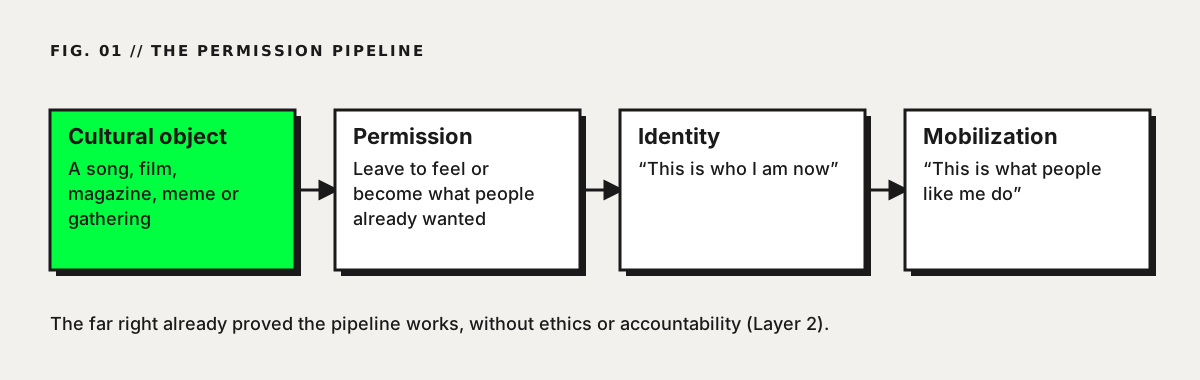
The mechanism I call the permission pipeline describes how cultural production generates political possibility:
Cultural object → Permission structure → Identity formation → Political mobilization
A cultural object — a song, a film, a magazine, a meme, a community gathering — gives a specific population permission to feel, think, or become something they already wanted but could not articulate. This permission creates identity: the feeling of this is who I am now. Identity creates political mobilization: this is what people like me do.
The McInnes Inversion: Why This Is Not Theory
The far right already proved this mechanism works. Gavin McInnes, co-founder of VICE Media, later architect of the Proud Boys, understood something that most progressive strategists still refuse to accept: cultural production is the most powerful tool for political mobilization, and the entity that controls the culture controls the politics.
McInnes did not build the Proud Boys by arguing policy. He built them by giving men permission — permission to be angry, permission to be transgressive, permission to reject norms that felt constraining, permission to belong to something that felt dangerous and cool. The cultural object came first. The political mobilization followed.
I was inside the machine that made this possible. As Publisher of VIRTUE Intelligence at VIRTUE Worldwide, the creative agency inside VICE Media, I watched the permission machinery McInnes helped build at VICE from the inside — and then watched him rebuild the same machinery, eight years after leaving, for the Proud Boys. Whether VICE “caused” or “enabled” that trajectory is a counterfactual question the evidence cannot answer, and this paper does not claim it. What the record supports is a mechanism identification: subcultural identity formation → transgressive permission structure → identity architecture → political mobilization. The same mechanism. Different ethics. Different target audience. Same structural output — at documented scale: START recorded 83 Proud Boys members or sympathizers who allegedly carried out ideologically motivated crimes as of December 2021, including 54 defendants in the January 6 Capitol breach (Jensen, Yates, & Kane, 2022). Ungoverned permission pipelines produce pro-social and anti-social outputs with equal efficiency, because the mechanism is value-neutral. Only governance determines direction.
This paper proposes the ethical inversion of that pipeline. Not because the mechanism is ideologically conservative — it is not. It is structurally neutral. It works for whoever deploys it with discipline. The question is not whether cultural production can manufacture political possibility. McInnes proved it can. The question is whether it can be deployed ethically, with accountability, toward repair rather than destruction.
The Permission Mechanism in Cultural Evidence
The permission mechanism is not new. It has been operating throughout human history wherever cultural production has generated political possibility. What is new is naming the mechanism and proposing its deliberate, ethical deployment.
Johnny Cash gave working-class white men permission to feel grief without shame. Selena gave Tejano communities permission to be simultaneously Mexican and American. Paul Wall — a white rapper from Houston who learned to rap in Spanish and wore grillz — gave Houston's multi-racial underclass permission to see cultural mixing as authentic rather than appropriative. Morrissey gave a generation of British misfits permission to be simultaneously masculine and sensitive. My Chemical Romance gave suburban teenagers permission to aestheticize their pain and call it art rather than weakness.
These are not examples of political campaigns. They are evidence. Each demonstrates that a cultural object that gives a specific population permission to feel, think, or become something generates identity formation and, eventually, political possibility. They are data points for a mechanism that has been operating in plain sight, undocumented as a general principle, because the people who study culture (ethnomusicologists, cultural studies scholars) do not usually speak to the people who study behavioral economics (Kahneman, Thaler, Sutherland), and neither group speaks to the people who study social movements (Tufekci, Chris Bail), and none of them speak to the people who design brands and political campaigns (where I spent a decade).
LAYER 3: THE CASCADE — A TEN-STEP MODEL FOR COORDINATED REPAIR
The theory proposes that systemic repair follows a specific causal sequence. Each link is testable, each transition has known failure modes, and the chain only produces durable outcomes when the sequence is respected. This is mechanism design in the sense developed by Hurwicz, Maskin, and Myerson — the engineering of incentive-compatible systems — applied not to markets but to the production of trust.
Listening → Legitimacy → Trust → Sources → Truth → Art → Gravity → Funding → Institutions → Policy Change
Listening → Legitimacy
Legitimacy → Trust
Trust → Sources
Sources → Truth
Truth → Art
Art → Gravity
Gravity → Funding
Funding → Institutions
Institutions → Policy Change
The cascade is not automatic. Each transition can fail. Understanding the failure modes is as important as understanding the mechanism itself. A theory that only describes success is not a theory. It is marketing.
LAYER 4: THE FOUR CYLINDERS — THE OPERATIONAL ENGINE
The cascade model requires four simultaneous operational functions, here called cylinders because, like an engine, they must fire in coordinated sequence to produce forward motion. This is the Switchboard: the institutional design that makes the cascade sustainable.
Cylinder 1: Journalism (Reinvented)
This paper does not propose redirecting existing journalism. Existing journalism is functionally incapable of performing the sensemaking role the cascade requires. It is underfunded, platform-captured, and structurally organized around a model that cannot survive in the current information environment.
Cylinder 2: Art and Cultural Production
The Truth → Art transition in the cascade is the most common failure point in progressive organizations. They produce reports. They produce fact sheets. They produce content optimized for their existing audience. They do not produce cultural objects that give new populations permission to feel, think, or become something.
The Promethean frame is useful here. Prometheus was not dangerous because he grabbed something. He was dangerous because he transferred something. Advertising, strategic communications, and narrative design — at their best — are technologies of transfer. We use them every day to sell products nobody needs to people who cannot afford them. The question this theory poses is not whether narrative design can manufacture intangible value. We know it can. The question is: what happens when we point it at problems that matter?
Cylinder 3: Mutual Aid
The most dangerous failure mode in progressive organizing is what I call the recipe fallacy: providing a framework without addressing the material conditions required for it to work. You cannot build trust infrastructure with hungry people. The mutual aid cylinder exists to close the gap between the narrative mechanism and the material reality.
Cylinder 4: Public Accountability Reporting
The Switchboard publishes its own failures. This is not humility theater. It is mechanism design. An institution that visibly documents its mistakes and explains what it learned from them generates more trust than an institution that claims to be infallible. The costly signal is the willingness to be wrong in public.
CRITICAL DESIGN CONSTRAINT: SUSTAINABLE WAGES
The Switchboard is explicitly designed not to become the next VICE. VICE Media's collapse demonstrated a specific failure mode: venture-capital growth expectations incompatible with the slow, trust-dependent work of cultural production. The Switchboard's financial model is designed around sustainable wages for practitioners — not below-market "passion wages" that extract surplus value from people who care too much to quit, and not above-market executive compensation that creates internal hierarchy. The target is professional-class compensation for professional-class work, funded through a diversified model that does not depend on any single source.
LAYER 5: THE SCARCITY DIVIDEND — SUPPORTING EVIDENCE
"They have the watches. But we have the time." — Afghan resistance saying
The Eurostar Problem at Species Scale
Rory Sutherland's Eurostar argument has become a foundational example in behavioral economics: engineers proposed spending £6 billion to reduce the London-to-Paris travel time by about forty minutes (his own telling of the story). Sutherland's counter was that for a fraction of the cost, you could provide free Wi-Fi and hire supermodels to serve Château Pétrus — and passengers would ask the train to slow down. The engineers measured value by speed because engineers value speed. The metric did all the work.
This paper proposes that an identical error operates at civilizational scale.
The dominant framework for assessing cultural "contribution" measures technological-scientific output: inventions, GDP, military capacity, institutional innovations. By this metric, Western Europe, China, and the United States rank highest. Aboriginal Australia — sixty-five thousand years of continuous civilization — ranks near zero. Jamaica — a small island of 2.8 million people that invented reggae, ska, dancehall, dub, sound system culture, jerk seasoning, and the global template for resistance-through-joy — is invisible.
The metric is not wrong. It is incomplete. And the incompleteness is not random. It systematically undervalues exactly the cultures whose contributions are most relevant to this paper's central claim: that intangible psychological infrastructure is the binding constraint on everything else.
The Alternative Metric: Vibes + Sadaqah Jariyah
I propose an alternative metric: compounding life-enriching value per unit of investment. The term draws on the Islamic concept of sadaqah jariyah (ongoing charity) — the category of good that continues to generate benefit long after the original act. A well that keeps giving water. A song that keeps healing people. A dish that keeps bringing strangers together.
The metric has two dimensions: absolute output (total compounding intangible value produced) and ROI (output relative to material resources, population, and institutional support). The ROI dimension is where the scarcity dividend becomes visible.
The colloquial term "vibes" is used deliberately. The academic equivalent would be "ambient experiential infrastructure that produces positive affective states, social bonding, and meaning-generation without requiring conscious cognitive engagement." The colloquial term is better because it captures what the academic term cannot: this value is felt before it is thought, experienced before it is measured, and shared before it is articulated. The entire argument of this paper is that the most important forms of human value operate below the threshold of rational articulation — and that our failure to measure them is not evidence that they do not exist but evidence that our metrics are impoverished.
The Scarcity Dividend: Empirical Pattern
Chris Rock has a comedy bit about boxing: the poorer the country, the better its fighters. You don't see a lot of Swiss boxers. This observation, delivered as humor, encodes a structural insight: scarcity produces disproportionate excellence in domains where material resources are not the binding constraint.
In boxing, the binding constraint is hunger — literal and figurative. The same structural dynamic operates in cultural production. When a population is denied access to material power — capital, institutions, military force — it does not stop producing value. It redirects production into the domains that remain available: music, food, spiritual practice, oral tradition, embodied knowledge, and the art of making life bearable under conditions designed to make it unbearable.
This is the scarcity dividend: the empirically observable pattern in which cultures with the least material investment produce the highest returns on intangible value. It is not romantic. It is not an argument that poverty is good. It is a structural observation about where human creative energy flows when material channels are blocked.
| Culture | Material investment | Evidence of compounding value |
|---|---|---|
| Jamaica (2.8M) | Minimal | Reggae, ska, dancehall, dub, sound system culture, jerk, Rastafari. The global template for resistance-through-joy. Bob Marley is among the most recognized humans in history. Population: smaller than Brooklyn. |
| Pakistan (230M) | Low | Qawwali (Nusrat Fateh Ali Khan rewired global music). Coke Studio Pakistan: the most successful cultural diplomacy project of the 21st century. Truck art. Biryani. Urdu ghazal. A nuclear-armed country whose most powerful export is music that makes people weep. |
| Cuba (11M) | Minimal | Son, salsa, Buena Vista Social Club. The best healthcare-to-GDP ratio on earth. An entire musical tradition that makes sadness physically impossible. Produced under sixty years of embargo. |
| West Africa (~400M) | Low | Root system of blues, jazz, funk, hip-hop, Afrobeat. Griot tradition. Jollof rice. Yoruba spiritual systems → candomblé, Santería, vodou. Still compounding after five centuries. |
| Gnawa (~2M practitioners) | Near zero | Tagnawit ceremony: 700-year-old collective healing technology through rhythm. The karkaba is a psychedelic you play with your hands. Zero institutional support. Infinite compound returns. |
| New Orleans (~380K) | Low | Jazz. Second line. Gumbo. Mardi Gras. One American city that outproduces most civilizations on the intangible axis. Katrina proved the government valued the real estate more than the people. The people proved the value was never in the real estate. |
| US (control) | Maximal | Almost all American vibes contributions — jazz, blues, hip-hop, soul food, gospel, rock and roll — were produced by populations America invested the least in. The dominant culture’s independent intangible output, controlling for its oppressed populations, is the Super Bowl halftime show and ranch dressing. |
Pakistan: The Intangible Superpower
Pakistan deserves its own case study because it is the single most underrated civilization on earth by the conventional metric, and the most instructive example of the scarcity dividend at national scale.
Nusrat Fateh Ali Khan did not merely popularize a genre. He rewired the global understanding of what the human voice can do. His collaborations — Eddie Vedder, Peter Gabriel, Michael Brook, Massive Attack — crossed every boundary the technological-scientific metric assumes are permanent. Jeff Buckley cited him as a primary influence. A single Pakistani musician, from a family of qawwals stretching back six hundred years, produced more compounding global emotional impact than most nation-states manage in a century.
Coke Studio Pakistan is the single most successful cultural diplomacy project of the twenty-first century, and almost no Western policy institution has noticed. It took the Sufi musical tradition and combined it with contemporary production, cross-regional collaboration, and a YouTube-native distribution strategy. Individual episodes have hundreds of millions of views. The series demonstrated that tradition + production + distribution = compound cultural returns. This is exactly the mechanism the Switchboard proposes.
Pakistan has spent seventy-five years dealing with partition trauma, military coups, IMF structural adjustment, proxy wars, drone strikes, and chronic governance failure. Its cultural output during that same period has been world-class. The ratio of output to investment is staggering. This is the scarcity dividend at national scale.
Theoretical Significance of the Scarcity Dividend
The scarcity dividend provides the evidentiary base for this paper's central claim. If the technological-scientific metric were sufficient — if material capability were the binding constraint on human flourishing — then the materially wealthiest cultures would produce the richest human experience. They do not. The scarcity dividend demonstrates empirically that the relationship between material investment and intangible output is often inverse. This is only explicable if intangible value operates on a different production function than material value — which is exactly what this paper claims.
The scarcity dividend is not an argument that poverty is good. It is an argument that the people who produced extraordinary meaning under extraordinary constraint deserve extraordinary investment — and that the return on that investment, measured in trust, belonging, and shared reality, will exceed anything the technological-scientific metric can predict.
LAYER 6: THE ARAB SPRING — THE STORY THEY WOULDN'T LET ME TELL
The dominant narrative of the Arab Spring is a technology story. In the American telling, the uprisings that swept Tunisia, Egypt, Libya, Syria, Bahrain, and Yemen between 2010 and 2012 were a "Twitter revolution" — proof that social media platforms could enable democratic mobilization in authoritarian contexts. This narrative was amplified by Silicon Valley, which had an obvious interest in positioning its products as tools of liberation, and by Western media, which found the technology angle more legible than the cultural one.
The technology narrative is not wrong. It is catastrophically incomplete. And the incompleteness is not accidental — it is the predictable output of a sensemaking architecture that systematically overvalues technological mechanisms and undervalues cultural ones.
The Arab Spring was not a Twitter revolution. It was a hip-hop revolution that used Twitter for distribution. The distinction matters because it reveals where the actual power was — and it was not in the platform.
The evidence has been available since 2011 and has been documented by scholars at Harvard, openDemocracy, NPR, and multiple ethnomusicology journals. The Harvard International Review documented that Tunisian rapper El Général's "Rais Lebled" was chanted by protesters not just in Tunisia but in Egypt and Bahrain. OpenDemocracy's extensive reporting demonstrated that hip-hop played a genuinely vital role in the Tunisian Revolution. Academic researchers have traced how Arabic hip-hop provided the cultural language of dissent years before any platform amplified it.
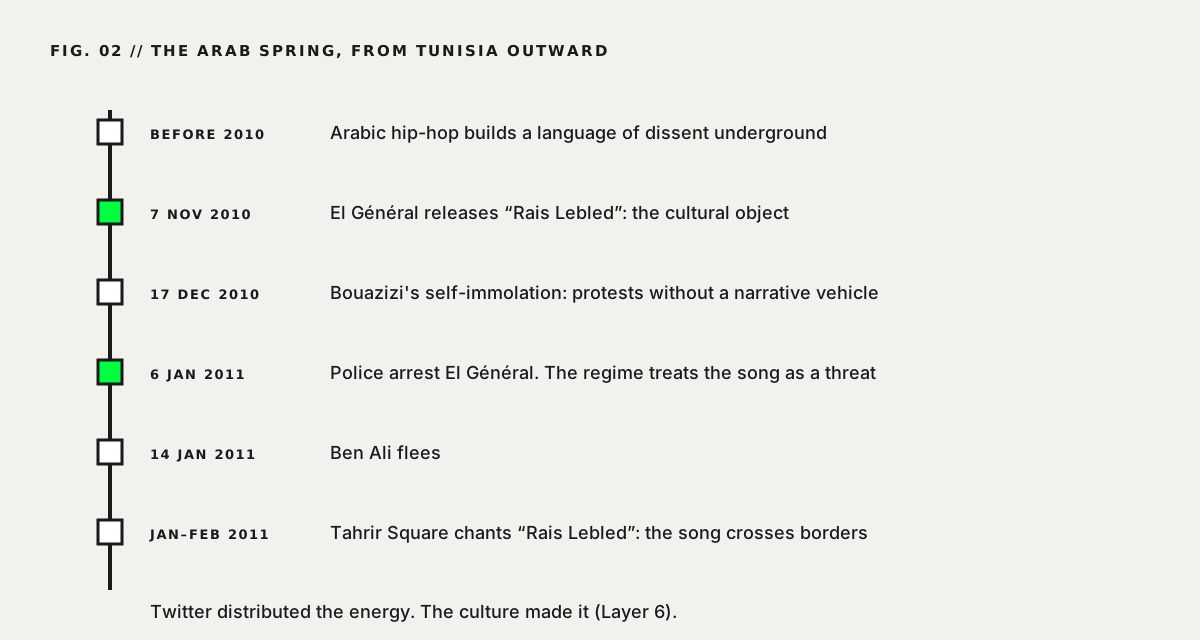
What happened in Tunisia is a textbook demonstration of the permission mechanism:
PRE-2010 Arabic hip-hop develops underground across Tunisia, Egypt, Morocco, Palestine. Rappers develop the cultural language of dissent — not policy critique but emotional permission to express what everyone privately knows. This is intangible infrastructure being manufactured, invisibly, over years.
NOV 7, 2010 El Général releases "Rais Lebled" on Tunisia's national holiday — directly addressing President Ben Ali, indicting corruption, youth unemployment, and security force brutality. No Tunisian artist had done this so openly. The cultural object enters circulation.
DEC 17, 2010 Mohamed Bouazizi's self-immolation sparks protests. The world barely notices. The protests have energy but no narrative vehicle — until "Rais Lebled" provides one.
JAN 6, 2011 Secret police arrest El Général. This is the moment the regime proves the theory: by treating the cultural object as a threat, they confirm it IS a threat. The arrest generates more international attention than weeks of protests. The costly signal was not a tweet. It was the arrest of the rapper.
JAN 14, 2011 Ben Ali flees. Hip-hop emerges from underground. The cultural landscape is permanently altered.
JAN-FEB 2011 The music crosses borders. Tahrir Square protesters chant "Rais Lebled." Omar Offendum releases "#Jan25 Egypt" with Arabian Knightz. Libyan-American Abdulla Darrat connects Libyan hip-hop artists to the uprising online. The cultural pipeline is transnational. The platforms distribute. They do not produce.
The Analytical Point
Twitter and Facebook did not create the revolutionary energy. They distributed it. The energy was manufactured by cultural production — hip-hop, punk, spoken word, street art — that gave populations permission to feel and express what they already privately knew. The Arab world under authoritarian rule was a Pretend Era — populations performing compliance despite widespread private dissent. The cultural production broke the performance. The platforms amplified the break.
The sequence matters enormously. If you credit the platform, you invest in more platforms. If you credit the culture, you invest in cultural infrastructure. The West credited the platform. Silicon Valley got the credit. The rappers got a few magazine profiles and then obscurity. The policy conclusion was: promote social media access. The correct policy conclusion would have been: invest in the cultural practitioners who manufacture permission, and let the platforms do what platforms do.
The Institutional Confession: "There Isn't Budget for This"
I tried to report this story — the role of hip-hop and punk in the Arab Spring — while working at VICE Media, the institution best positioned to tell it. VICE's founding identity was built on exactly this kind of cultural-political reporting.
The response was: "There isn't budget for this."
This is not an anecdote. It is a data point. The institution best positioned to tell the true story could not, because its economic model — by then dependent on platform-driven scale metrics and venture capital growth expectations — could not justify investment in a story that was culturally rich but algorithmically unpredictable. The story that did get told — the Twitter revolution narrative — was told because it was the story the captured attention economy could metabolize.
They funded the pipe and let the water dry up. Then they wondered why no more revolutions came out of the pipe.
LAYER 7: THE INTELLECTUAL TRADITIONS — WHAT THIS BUILDS ON
This theory does not claim originality in any single insight. It claims originality in synthesis: assembling observations from across intellectual history into a unified operational framework. Every scholar and practitioner cited below contributed a piece. None assembled the full machine. The generous citation is deliberate — both because intellectual honesty requires it and because the gap between their contributions and this framework's contribution becomes most visible when the debts are clearly stated.
Cluster 1: Counter-Hegemonic Theory — How Power Is Contested
Václav Havel demonstrated that parallel institutions — structures that perform the functions the state claims to perform but actually doesn't — create an existential trap for incumbent power. This theory's "shadow office" concept is a direct application of Havel's parallel polis. Antonio Gramsci, accessed through Vivek Chibber's analytical framework, established that cultural power precedes political power. Rosa Luxemburg demonstrated that reform and revolution are not opposites but phases of the same process. Frantz Fanon understood that liberation without psychological decolonization is incomplete.
What I add: The operational mechanism for actually building the parallel institutions — the four-cylinder engine, the cascade sequencing, the financial model. Havel diagnosed. Gramsci theorized. This paper engineers.
Cluster 2: Liberation Pedagogy — How Consciousness Changes
Paulo Freire established that education is either a tool of liberation or a tool of domestication, and that the oppressed must participate in designing their own liberation. bell hooks understood that love is a practice, not a feeling, and that a politics incapable of metabolizing love will reproduce the violence it opposes. Bayard Rustin demonstrated that effective organizing requires strategic sophistication, coalition-building, and the willingness to be unpopular with your own side. James Baldwin understood that the capacity to love in a system designed to destroy you is itself a revolutionary act.
What I add: The conversion from pedagogy to mechanism design. Freire's work is about consciousness; this paper is about manufacturing the conditions under which consciousness can produce coordinated action. The gap between awareness and action is the coordination gap — and that is the gap this framework is designed to close.
Cluster 3: Behavioral Economics and Strategic Practice
Rory Sutherland demonstrated that perceived value can be transformed without changing objective reality — through reframing, context design, and emotional architecture. His Eurostar argument is the seed of this paper's civilizational metrics critique. Daniel Kahneman and Amos Tversky established that human decision-making is driven by heuristics and biases rather than rational calculation. Richard Thaler and Cass Sunstein demonstrated that choice architecture can redirect behavior without coercion. Elinor Ostrom proved that communities can self-govern common resources without privatization or state control when institutional design supports cooperation.
What I add: The application of behavioral economics to civilizational repair rather than consumer behavior. Sutherland reframes train journeys. Thaler nudges retirement savings. I am proposing that the same toolkit — choice architecture, costly signaling, framing effects, identity-based decision-making — can be deployed to manufacture trust, coordinate collective action, and reverse institutional collapse. This is the leap nobody has made because the people who understand behavioral economics work in advertising and policy, not in social movements.
Cluster 4: Media Criticism and Cultural Theory
Zeynep Tufekci demonstrated how platforms simultaneously empower and undermine movements. Jean Baudrillard predicted the hyperreal: a world where representations become more real than reality. Chris Hedges demonstrated that institutional journalism's commitment to "balance" functions as a mechanism for normalizing extremism. Naomi Klein revealed how narrative framing determines whether crisis produces reform or extraction. Chris Bail at Duke has documented how social media's structure amplifies extreme voices and suppresses moderate ones, creating a distorted picture of public opinion that reinforces pluralistic ignorance.
What I add: The inside view. I was in the machine. I watched VICE Media's cultural pipeline become a political pipeline. I designed brand strategy campaigns that used the permission mechanism for Michelin, and saw how the same mechanism was being weaponized by the far right. The theoretical critique exists. What hasn't existed is a practitioner who has operated on both sides of the production line and can describe the engineering with precision.
Cluster 5: Islamic Intellectual Tradition
Abu Hamid al-Ghazali (1058-1111), one of the most important thinkers in Islamic intellectual history, anticipated the core insight of behavioral economics by nine centuries. In Ihya Ulum al-Din (The Revival of the Religious Sciences), al-Ghazali systematically analyzed how human behavior is driven by nafs (the ego/self), habit, and social pressure rather than rational deliberation — and proposed structured interventions for redirecting behavior through environmental design, habit formation, and community accountability. This is choice architecture before the term existed. Ibn Khaldun (1332-1406) developed the concept of asabiyyah (social cohesion/group feeling) as the binding constraint on civilizational rise and fall — the same structural role that intangible infrastructure plays in this paper.
What I add: The recognition that sadaqah jariyah — ongoing charity that compounds — provides a metric for measuring intangible value that Western economics has not developed. And the observation that al-Ghazali's behavioral interventions and Kahneman's nudges are doing the same work separated by nine centuries, which suggests the insight is robust and cross-culturally valid.
LAYER 8: METHODOLOGY — WHY NOBODY FOUND THIS YET
The synthesis requires exactly the cross-domain trajectory that the academy treats as unfocused rather than as a methodology. It started with a ten-year-old boy who was told he was a terrorist.
A reasonable reader at this point asks: if the individual insights are not new — if Havel understood parallel institutions, if Sutherland understood reframing, if Kahneman understood heuristics, if Tufekci understood platform dynamics, if al-Ghazali understood behavioral intervention — why hasn't anyone assembled them before?
The answer is structural, not intellectual — and it is itself evidence for the theory's diagnosis. But before I explain the structural answer, I need to explain the personal one. Because the methodology that produced this framework did not begin with a literature review. It began with an injury.
The Origin: Epistemic Injury, Arizona, 2001
I was ten years old, living in Arizona, when the planes hit the towers. Within days, I was told — by classmates, by adults, by the ambient information environment of the Bush-era United States — that I was a terrorist. I was not. I was a child. But the machinery of mainstream media was talking about Muslims constantly and featuring them almost never, and the gap between what was being said about people like me and what I knew to be true was the first encounter with what I would later learn to call epistemic injury: harm inflicted not through violence but through the systematic distortion of your reality in the public record.
While other kids played, I debated. I spent years — from the age of ten — arguing against the folly and hubris of the Iraq war, trying to overcome the cultural and religious ignorance that the sensemaking architecture of American media had manufactured. I was not an activist. I was a child defending my own humanity in real-time against a narrative machine that had decided what I was before it had met me.
That experience taught me two things that no graduate seminar could have: first, that the narrative is the battlefield — the war I was fighting was not over policy but over the story that made the policy feel inevitable. And second, that the people most harmed by sensemaking failure have the most precise understanding of how it works, because they experience it from the inside, as lived reality, not as data.
The American Muslim Teenager's Handbook
That epistemic injury produced my first intervention. As a teenager, I co-authored The American Muslim Teenager's Handbook — a book designed to do what the mainstream narrative would not: give young American Muslims a cultural object that told them they were real, that their experience was valid, and that they did not have to choose between being American and being Muslim. The book was reviewed by the New York Times and profiled on NPR. It was a small thing. But it was the first time I operated the permission mechanism consciously: create a cultural object that gives a specific population permission to feel something they already know.
I was a teenager. I did not know the phrase "permission mechanism." I did not know Kahneman or Ostrom or al-Ghazali. But I knew the mechanism worked because I watched it work — I watched kids pick up that book and feel recognized for the first time. That is data. It is the first fragment of proof.
Duke: The Intellectual Infrastructure
The book profiles led to Duke University, where I studied economics and public policy at the Sanford School of Public Policy. But the official curriculum was only half the education. The other half was a set of mentors and experiences that, in retrospect, each deposited a specific capability into the toolkit that would eventually produce this framework.
Phil Bennett — the former managing editor of the Washington Post — flew in from Boston one day every week to teach a capstone class in Duke's Policy Journalism and Media Studies certificate program. The class never exceeded twelve students. He brought Pulitzer Prize-winning journalists as guest speakers so regularly that the average Pulitzer count of the guests was over one. Bennett taught me what institutional journalism looks like when it is actually working: the editorial discipline, the evidentiary standards, the willingness to kill a story that does not meet the bar. This is the DNA of the Switchboard's journalism cylinder — not the VICE model, not the platform model, but the Post model, miniaturized and redistributed.
Tim Lenoir — the historian of science and technology — let me take his graduate seminar as an undergraduate. Lenoir brought me to Deleuze and Guattari, to McLuhan, to Baudrillard. He had been present for Doug Engelbart's demonstration of the first computer mouse. He taught us to map the ethical impacts of technology and to understand technology anthropologically — not as neutral tools but as extensions of human intention embedded in institutional power structures. This is where I learned that the attention economy is not a market failure. It is an engineering success. It is doing exactly what it was designed to do. The framework's critique of platform capitalism is built on Lenoir's foundations.
Diane Weddington taught journalism and became an early advisor to what would eventually become Aux Labs. She urged me to pursue grant funding and build institutional stability before chasing clients. I did not listen — I was too punk, too DIY, too impatient. In retrospect, she was right, and her advice anticipated a structural lesson it took me years to learn the hard way: the recipe fallacy applies to your own institution too. You cannot build trust infrastructure without material stability. I owe her an apology and a citation.
Alongside the formal education: I co-founded the Duke chapter of Students for Sensible Drug Policy — my first experience designing a political intervention from scratch. I studied cryptography and its implications for journalism — the insight that source protection is a technical problem, not just an ethical one, which directly informs the Switchboard's intelligence-community methodology for citizen journalism. I played Afro-Cuban drums — batá, congas, timbales — which gave me embodied knowledge of how rhythm manufactures collective psychological states, knowledge that no amount of reading about music could replicate. I learned Italian, which later proved relevant in ways I could not have predicted. And I earned a certificate in Policy Journalism and Media Studies under Bennett.
Every one of these experiences deposited a specific tool. None of them looked like they were building toward a unified framework. All of them were.
VICE: Inside the Machine
When I graduated from Duke, I had options that would have made my resume legible: Booz Allen Hamilton, the State Department. I chose VICE Media instead — two successive internships, unpaid, because VICE was the only institution in the world that sat at the intersection of journalism, cultural production, and youth identity formation. It was the machine. I wanted to understand the machine.
My first internship was with VICE on HBO, where I worked directly under Basim Usmani and Abdullah Saeed of the Kominas — the Pakistani-American taqwacore punk band that had been my musical heroes before they were my bosses. The Kominas had done exactly what this paper describes: created a cultural object (taqwacore punk) that gave a specific population (South Asian Muslim kids in the diaspora) permission to be simultaneously Muslim, punk, American, and furious. They were living proof of the permission mechanism. Working under them at VICE meant I was learning the theory and operating the practice simultaneously — inside the institution that was, at that moment, the most powerful cultural permission machine on earth.
The second internship was at VICE News, then a summer at Motherboard — VICE's technology vertical. From there I joined VICELAND and began making television. Then I switched tracks: researcher, creative, strategist, and ultimately Publisher of VIRTUE Intelligence at VIRTUE Worldwide, VICE's creative agency. Each role gave me a different angle on the same machine: how cultural production is manufactured, how it is distributed, how it is monetized, and how the monetization model eventually destroys the cultural production that made it valuable.
At VIRTUE, I was publishing insights that used behavioral economics to decode cultural movements for brand clients. I was operating the permission mechanism for Michelin, for Super Bowl campaigns, for global brands. And I was watching, from inside, as the institution that had built the most powerful cultural pipeline of the twenty-first century systematically destroyed it — through venture-capital growth expectations, platform dependency, and an economic model that could not justify investing in the stories that mattered.
The clearest test came on a master brand project. I recommended more equitable compensation structures and returning creative agency and equity to the people who actually made the work. The institution did not give the recommendations real consideration. This is not a grievance. It is a data point. The institution that understood cultural production better than anyone could not sustain itself because the economic model was designed for extraction, not for the kind of slow, trust-dependent, relationship-intensive work that cultural infrastructure requires. VICE's collapse, which I watched from inside and then from outside, is the negative proof for the Switchboard: it demonstrates precisely the failure mode the Switchboard is designed to avoid.
Founding the Practice Under COVID: Necessity as Design Constraint
COVID hit. The world locked down. And I started the practice that would become Aux Labs — not because the timing was strategic but because the timing was necessary. The pandemic was the Pretend Era made visible: institutional failures cascading across every system simultaneously, the gap between what was claimed and what was delivered becoming undeniable, and the populations who had always known the systems were broken finally being joined by populations who had previously been comfortable enough to pretend otherwise.
The practice was designed from the beginning as the ethical inversion of VICE: sustainable wages instead of passion exploitation, community accountability instead of platform metrics, cultural production funded through trust infrastructure instead of venture capital. Every design choice was informed by a specific failure I had watched from inside the machine.
The Disciplinary Silo Problem
This biographical trajectory explains why me. But the structural question remains: why hasn't the academy produced this synthesis independently? The answer is that academic incentive structures keep researchers in disciplinary lanes. The behavioral economist does not read ethnomusicology. The ethnomusicologist does not read mechanism design theory. The brand strategist does not read Paulo Freire. The Islamic philosopher is not cited in behavioral economics journals.
Bisin and Verdier at NYU and the Paris School of Economics have spent decades producing rigorous formal models of cultural transmission — how cultural traits propagate across generations. Their work is mathematically sophisticated. But it is focused entirely on transmission — how culture passes between people. It has nothing to say about production — how you manufacture the cultural objects that create permission structures in the first place. They can model why reggae persists. They cannot explain why Jamaica produced it.
Acemoglu and Robinson at MIT have modeled the interaction between culture and institutions as social equilibria. Their framework treats culture as a variable that influences economic outcomes. This paper treats culture as a technology that can be deliberately deployed. The difference is the difference between meteorology and engineering: one studies weather patterns, the other builds airplanes.
The Arab Spring hip-hop scholars produced excellent work — Harvard International Review, openDemocracy, ethnomusicology journals. But they treated the story as a story about hip-hop and the Arab Spring. Nobody connected it to a general theory of permission mechanisms, or to the attention economy's structural inability to see cultural mechanisms, or to the institutional confession of "there isn't budget for this."
The Same Mechanism Under Different Names
The pattern-recognition that produces this framework comes from seeing the same mechanism operating across different domains under different names. Brand strategists call it "brand permission." Movement organizers call it "consciousness-raising." Behavioral economists call it "choice architecture." Islamic scholars call it "tahdhib al-nafs" — refinement of the self. Cultural studies scholars call it "hegemonic contestation." Musicians call it "vibes."
These are all descriptions of the same underlying process: the manufacturing of intangible psychological conditions that enable new behaviors. Nobody has assembled them into a single framework because nobody has operated in all these domains. The academy rewards depth within a discipline. This work requires breadth across disciplines. The two incentive structures are structurally incompatible.
That is why the synthesis has to come from someone who got told he was a terrorist at ten and spent the next twenty years moving through every domain where humans make meaning — not to build a resume, but to understand a problem that was, at its root, always the same problem: the machinery that determines what is real is broken, and nobody who operates only one piece of it can see the whole machine.
The Practitioner Advantage
There is a specific advantage that practitioners have over theorists in assembling this kind of synthesis: practitioners encounter failure. When I designed a brand strategy for Michelin that used narrative gravity to redirect corporate spend into a new vehicle for the Grand Central Food Program — a grant the program’s executive director confirmed to the author in August 2026 — serving roughly 200 additional people nightly at the time (service figures last confirmed 2017; current levels to be confirmed), I did not just observe the mechanism. I operated it. When the Greg Stoker congressional campaign failed at the exact transition point the cascade model predicted, I did not just theorize the failure mode. I lived inside it.
Failure teaches you what theory cannot: where the transitions break. The cascade model's failure mode documentation — the most analytically valuable part of the framework — comes from two decades of watching things go wrong in specific, predictable ways. The epistemic injury at ten. The VICE collapse from inside. The campaign that failed exactly as predicted. The grant applications I should have written and didn't because I was too punk to ask for help. Each failure deposited a specific piece of diagnostic precision that no amount of theorizing could have produced.
A theory that only describes success is not a theory. It is marketing.
LAYER 9: EVIDENCE AND FALSIFIABLE PREDICTIONS
A theory that cannot be wrong is not a theory. It is a belief. This section presents the evidence that currently exists and the predictions that would, if they fail, require revision or abandonment of the framework.
Fragmentary Evidence (Exists)
A set of applied projects demonstrates that individual cascade transitions produce predicted outcomes: the Michelin campaign (Art → Gravity → Funding → Material Outcome), a listening-infrastructure pilot designed for a Texas civil-liberties organization (Listening → Legitimacy → Trust; designed and protocol-complete — the grant was not funded, so it stands as design evidence, not field evidence), Super Bowl advertising work (permission mechanism at mass scale), State Department public-diplomacy work (Generation Change; embassy web-chats under the Special Representative to Muslim Communities — cultural production as diplomatic infrastructure), crisis communications engagements (Trust → Sources → Truth under adversarial conditions), and an immersive theater experience designed to combat disinformation. Each demonstrates a fragment. None demonstrates the complete sequence.
Documented Negative Result (Exists)
The Greg Stoker Congressional Campaign (2025–2026). A Green Party candidate in Texas’ 31st District hired my team as Director of Strategy; the full four-cylinder architecture was designed, and the theory specified the failure modes that would follow if structural conditions were not met. They were not: brand authority was granted verbally and revoked structurally within 36 hours (Listening → Legitimacy failure), aesthetic decisions were overridden without domain expertise (Truth → Art failure), and the campaign launched publicly before the brand architecture was complete (Art → Gravity failure). Every failure occurred in the predicted sequence — not “they wouldn’t let me try, which proves my point,” but a set of pre-specified failure modes arriving on schedule once the predicted conditions were present.
Falsifiable Predictions
Prediction 1: Intangible-First Outperforms Policy-First
Narrative interventions that manufacture intangible value (trust, legitimacy, belonging) before policy deployment will produce measurably higher adoption rates than policy-first approaches. Test: Controlled comparison of matched communities receiving identical policy interventions with and without preceding narrative infrastructure. The Texas civil-liberties pilot provides the bounded protocol, designed and ready; funding was not secured on the first pass. Cost: \~$30,000. Timeline: 10 months. Failure looks like: no measurable difference between communities with and without narrative infrastructure.
Prediction 2: Brand-Funded Public Goods Produce Superior Brand Outcomes
Brand-funded public-good outcomes designed through this framework will generate higher long-term brand equity than equivalent spend on traditional CSR — while simultaneously producing durable social outcomes. Test: Longitudinal brand-equity measurement paired with social-impact assessment, ideally through the IPA or Ehrenberg-Bass Institute. Failure looks like: framework-designed interventions produce equivalent or lower brand equity than traditional approaches.
Prediction 3: Coherence Beats Scale
Small teams operating with high coherence (shared diagnostic comprehension + aesthetic alignment + structural authority clarity) will outperform larger, better-funded organizations optimizing for reach or ideological purity — measured by sustained behavioral change over 12-36 months. Failure looks like: coherent teams are outperformed by larger teams scoring below coherence threshold, controlling for resources.
Prediction 4: The Scarcity Dividend Is Replicable Under Institutional Support
Cultural practitioners from high-intangible-ROI traditions, when provided with material security and distribution infrastructure through a Switchboard-type model, will produce interventions that generate measurably higher trust and belonging than equivalent-cost interventions designed by institutional professionals without embedded cultural expertise. Test: Controlled comparison, twelve-month window. Failure looks like: no measurable difference, suggesting cultural expertise is not transferable.
CLOSING: WHAT SUCCESS LOOKS LIKE
Not utopia. Not revolution overnight. Cascading marginal improvement: small gains that reinforce each other, coordinated so they do not cancel each other out, sequenced so people do not feel overwhelmed. Two-to-five percent improvements across many systems, compounding over time. This is how civilizations actually change.
People trusting shared reality again — not because they are naive, but because credible institutions have earned that trust through visible, costly commitment to truth.
Movements that do not eat themselves — because they are built on shared material benefit and operational care, not ideological purity tests.
Journalism that stabilizes instead of inflames — because it is structurally independent and accountable to communities it serves.
Art that moves people again — because it is freed from algorithmic optimization and funded through mechanisms that prioritize human impact.
AI companies with trust infrastructure they didn't have to build from scratch — because the Switchboard provides the legitimacy architecture that technology alone cannot manufacture.
Ethics that feel powerful instead of preachy — because they are demonstrated through sacrifice, not declared through rhetoric.
Strategy that does not require lying to work — because the mechanism generates genuine value rather than extracting it.
The Call
The fragments have been tested. The failure modes have been documented. The bounded pilots are proposed. The intellectual traditions converge. The tools exist. The machinery works. What remains is assembly.
This theory is offered as a falsifiable framework — with honest limitations, explicit failure conditions, and the commitment to revise or abandon it if the evidence requires. It is offered by a practitioner who has spent a decade building fragments of proof across every domain where humans make meaning, and who is now, finally, able to articulate what those fragments add up to.
The Switchboard requires multi-year operating funding. It requires institutional partnership for the academic validation. It requires IP protection before major disclosure. It requires practitioners who are paid sustainable wages to do the most important work of their careers.
The question is not whether this approach is viable. The evidence suggests it is. The question is whether we are willing to assemble the full mechanism and measure the results.
Trying new things feels risky. Continuing like this is suicidal.
References
Acemoglu, D., & Robinson, J. A. (2021). “Culture, Institutions and Social Equilibria: A Framework.” NBER Working Paper 28832.
al-Ghazali, Abu Hamid. Ihya Ulum al-Din (The Revival of the Religious Sciences). c. 1097.
Bisin, A., & Verdier, T. (2001). “The Economics of Cultural Transmission and the Dynamics of Preferences.” Journal of Economic Theory, 97(2), 298–319.
Doctorow, C. (2023). “Enshittification.” Pluralistic.
Fanon, F. (1961/1963). The Wretched of the Earth. Grove Press.
Freire, P. (1970). Pedagogy of the Oppressed. Herder and Herder.
Gramsci, A. — accessed through Chibber, V. (2022). The Class Matrix: Social Theory After the Cultural Turn. Harvard University Press.
Hafiz, D., Hafiz, I., & Hafiz, Y. (2007/2009). The American Muslim Teenager’s Handbook. Acacia Publishing (2007); Atheneum Books for Young Readers (2009).
Havel, V. (1978). “The Power of the Powerless.” In Keane, J. (Ed.), The Power of the Powerless (1985). M. E. Sharpe.
hooks, b. (1994). Teaching to Transgress: Education as the Practice of Freedom. Routledge.
Hurwicz, L., Maskin, E., & Myerson, R. (2007). Nobel Memorial Prize lectures in mechanism design theory. Nobel Foundation.
Ibn Khaldun (1377). The Muqaddimah. (Rosenthal translation, Princeton University Press.)
Kahneman, D., & Tversky, A. (1979). “Prospect Theory: An Analysis of Decision under Risk.” Econometrica, 47(2), 263–291.
Katz, D., & Allport, F. H. (1931). Students’ Attitudes. Craftsman Press.
Klinenberg, E. (2018). Palaces for the People: How Social Infrastructure Can Help Fight Inequality, Polarization, and the Decline of Civic Life. Crown.
Kuran, T. (1995). Private Truths, Public Lies: The Social Consequences of Preference Falsification. Harvard University Press.
Luxemburg, R. (1900). Reform or Revolution.
Panayotopoulos-Tsiros, D., Garling, O., Marks, R., Alexandrova, A., Coyle, D., & Kenny, M. (2025). Measuring Social and Cultural Infrastructure. Bennett Institute for Public Policy, University of Cambridge. https://www.bennettschool.cam.ac.uk/wp-content/uploads/2025/04/Measuring-social-and-cultural-infrastructure.pdf
Ostrom, E. (1990). Governing the Commons: The Evolution of Institutions for Collective Action. Cambridge University Press.
Prentice, D. A., & Miller, D. T. (1993). “Pluralistic Ignorance and Alcohol Use on Campus.” Journal of Personality and Social Psychology, 64(2), 243–256.
Spence, M. (1973). “Job Market Signaling.” Quarterly Journal of Economics, 87(3), 355–374.
Sutherland, R. (2019). Alchemy: The Dark Art and Curious Science of Creating Magic in Brands, Business, and Life. WH Allen. (Eurostar: £6bn / ~40 minutes, per Sutherland’s own telling, e.g. TED 2009, “Life Lessons from an Ad Man.”)
Thaler, R. H., & Sunstein, C. R. (2008). Nudge: Improving Decisions About Health, Wealth, and Happiness. Yale University Press.
Tufekci, Z. (2017). Twitter and Tear Gas: The Power and Fragility of Networked Protest. Yale University Press.
Zahavi, A. (1975). “Mate Selection — A Selection for a Handicap.” Journal of Theoretical Biology, 53(1), 205–214.
Arab Spring section (Layer 6):
Gana, N. (2012). “Rap and Revolt in the Arab World.” Social Text, 30(4), 25–53.
openDemocracy. “Hip hop and the Arab uprisings”; “Hip Hop Revolution.” opendemocracy.net.
Qi, J. (2019, May 1). “Rap and Revolution: From the Arab Spring to ISIL and Beyond.” Harvard International Review. (“El General’s ‘Rais Lebled’… was on the lips of thousands of protesters, not just in Tunisia… but also in Egypt and Bahrain.”)
NPR Staff. (2011, June 9). “The Rap Songs of the Arab Spring.” The Record, NPR Music. https://www.npr.org/sections/therecord/2011/06/09/137067390/the-rap-songs-of-the-arab-spring (“Ben Amor’s arrest in early January sparked further protests… when the revolution ended, ‘Rayes Le Bled’ could be heard on radio stations across the country.”)
Beardsley, E. (2011, January 21). “Tunisians Embrace Life Without Censorship.” All Things Considered, NPR. https://www.npr.org/2011/01/21/133121640/Tunisians-Embrace-Life-Without-Censorship
Jensen, M., Yates, E., & Kane, S. (2022, January). “Proud Boys Crimes and Characteristics.” START, University of Maryland. https://www.start.umd.edu/publication/proud-boys-crimes-and-characteristics