1. Why it exists
The Switchboard exists because the people who understand a problem and the people who can fix it rarely sit in the same building. Think tanks publish and stop there. Movements act, but on adrenaline and with no time to ask whether they are aiming at the right target. Universities reward the narrow paper over the cross-disciplinary fix. The private sector has the best tools for moving behavior and points nearly all of them at selling things.
The diagnosis behind it is the Pretend Era (AXL-WP-04). Most people privately stopped believing the official story years ago. Each assumes everyone else still believes it, so everyone keeps performing. The first person to say so out loud pays the whole cost alone. You can’t exhort your way out of that equilibrium. You have to build the conditions that make the honest move cheap, and that is the Switchboard’s job.
The polycrisis
Underneath all of it is the polycrisis: climate disruption, a broken information environment, AI reshaping work faster than institutions can adapt, failing public health and housing systems, and collapsing trust in the institutions meant to respond. Edgar Morin introduced the term in the 1990s, and the historian Adam Tooze brought it back into use. Its point is that these crises are coupled. Each makes the others harder to solve, and together they do more damage than they would apart.
What couples them is the layer this work is about. Every response to every one of these crises runs through the same substrate: whether people trust the institution asking them to act, whether they can make sense of hard information together, and whether a coalition can form fast enough to matter. When that substrate fails, a good climate policy, a sound public-health message and a well-designed court reform all fail the same way, for the same reason. The Pretend Era is what that failure looks like from the inside.
That is the ultimate reason the Switchboard is built the way it is:
- It works on the shared substrate, not on one crisis. Every cycle it runs raises the capacity that every other effort depends on.
- It is polycentric. A shock that takes out one instance, one funder or one founder doesn’t take out the network, and each instance adapts to its own place, the way the commons Ostrom studied lasted for generations under local rules.
- Its teams cross disciplines because the problems do.
- It measures the substrate directly. The HSRI shows trust eroding before a crisis exposes it.
- It is built to outlast its founder. A response to a crisis that will run for decades can’t depend on one person’s tenure, health or judgment.
Aux Labs, the commercial lab, does that work for clients at market rates. Some of the work can’t have a client’s comfort in the room: the accountability reporting, the findings that embarrass a funder, the questions no buyer would pay to have asked. That work needs ground that isn’t for sale. The Switchboard is that ground. It also keeps the commercial side honest, because a wing nobody can buy is the proof that the wing people do pay for hasn’t been captured.
This comes from somewhere specific. At fifteen, after 9/11 made me a target at school, I co-wrote The American Muslim Teenager’s Handbook with my mother and sister. My work started in civil rights, and the two posters on my bedroom wall map onto the two vehicles: Martin Luther King Jr., working the system in a language power can hear, is Aux Labs. Malcolm X, self-determined and refusing the terms, is the Switchboard.
Duke, then VICE. Two different machines, one that decides who gets to speak and one that decides what gets heard. I spent 2013 to 2020 inside VICE and its agency VIRTUE and watched a cultural commons get built by thousands of people and then captured by a narrowing ownership structure they couldn’t see or influence (AXL-WP-01). Almost every governance choice in this paper is a response to something I watched go wrong there. I built the framework at my own expense, before any funding existed. I say that once because it’s data.
Rory Sutherland has been an advisor to me since 2020, and this program is in part an answer to his challenge that the next revolution will be psychological, not technological.
2. At a glance
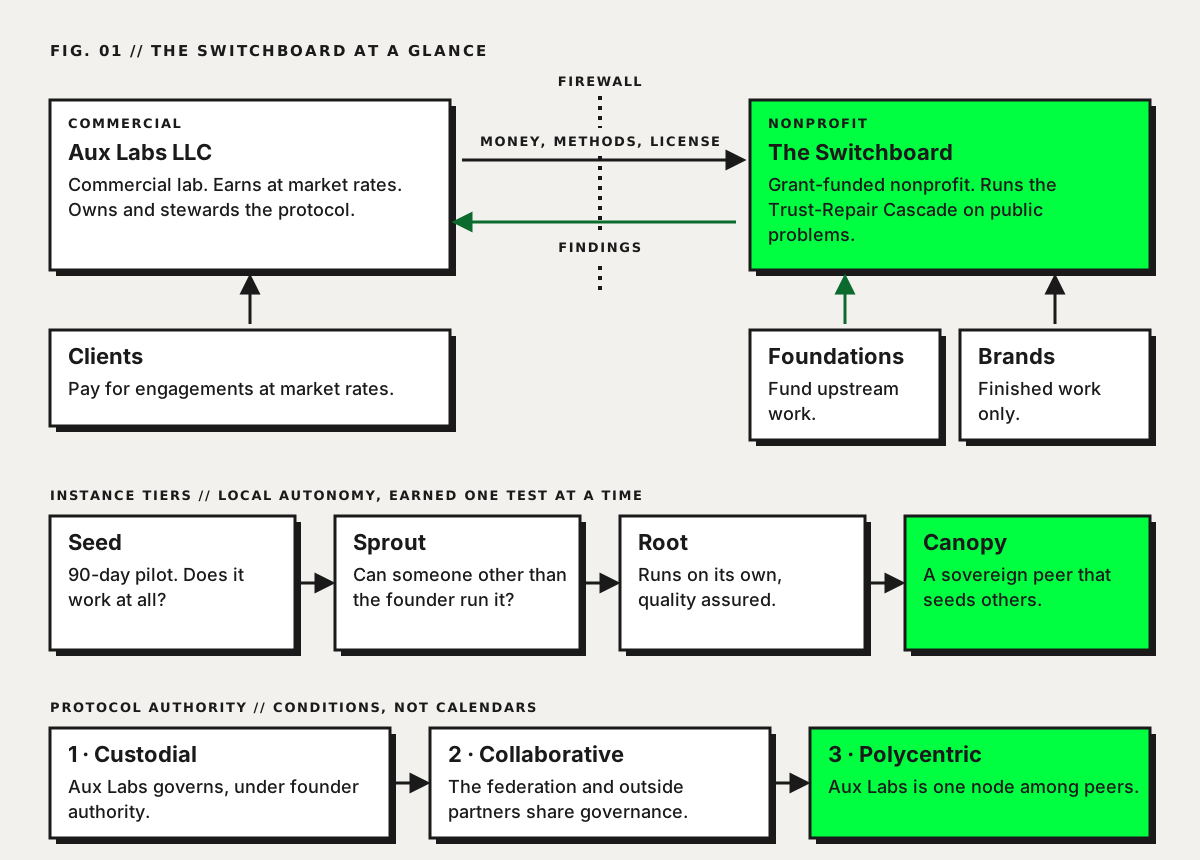
Aux Labs earns at market rates and sends money, methods and a license across the firewall. Findings come back the other way. Foundations fund the Switchboard’s upstream work, and brands may sponsor only finished work. The Switchboard seeds instances that move up through four tiers of local autonomy, while authority over the protocol itself passes from Aux Labs to the federation in three stages.
3. How it works
A Switchboard takes one bounded public problem at a time and runs it from listening to policy, in order, with every step measured. It does that on a repeating cycle, sequenced by a fixed cascade, carried out by four kinds of work, funded through a firewall, and checked by an open index.
The work cycle
Map → Diagnose → Design → Test → Deploy → Measure → Iterate. Each cycle targets one problem and runs three to six months. The team maps the system, finds the binding constraint, designs an intervention, tests it small, deploys it, and measures it against predictions written down in advance. Several cycles can run in parallel once a team is large enough to staff them.
The Trust-Repair Cascade
The cycle runs inside a fixed sequence, the Trust-Repair Cascade (Hafiz, 2026; specified in AXL-WP-03). Trust is built in a set order, spent in a set order, and breaks predictably when the order is skipped.
- Listening. Consensual signal intake from the community the problem actually belongs to.
- Legitimacy. Earned by being seen to act on what was heard.
- Trust. Produced only by costly signals, never by cheap talk.
- Sources. People share what they otherwise wouldn’t.
- Truth. Verified facts, documents, receipts.
- Art. The facts turned into forms that move people.
- Gravity. Cultural pull that makes participation voluntary.
- Funding. Capital follows visible legitimacy.
- Institutions. Durable structures that replace the ones that failed.
- Policy. The system adopts the change, or visibly refuses it.
Steps 1 to 3 make trust. Steps 4 to 10 spend it. Most well-funded interventions fail because they enter mid-chain. Craig Newmark has said he “really didn’t understand that audience development and related marketing needed to be a really big deal for everyone in journalism,” after nearly $200 million in journalism funding (Scire, Nieman Lab, 2026). In cascade terms, that money funded Step 5 without Steps 1 to 3 underneath it or Step 6 after it. My own failed 2022 cave-concert project with the Texas Cave Management Association broke the same way: it entered at Step 6 with no trust, no coalition, and no insurance under it (AXL-WP-03 §2.6).
Four cylinders
The work itself comes from four cylinders: investigative journalism, art and cultural production, mutual aid, and public accountability reporting. A coordinating layer, the Crankshaft, times them against the cascade so their output is continuous instead of one burst and then nothing. Mutual aid is not optional. A Switchboard that produces only journalism, art and advocacy, with no material support for the people involved, is itself a performance of repair. Which cylinder fires against which stage, and in what order, is proprietary method; partners can read it under NDA.
The firewall
Money enters under the published rules of The Firewall (AXL-FW-01), which bind the Switchboard the same way they bind Aux Labs. The preferred order is strict. Grants and academic funding carry a cascade cleanly from Listening up to the creative idea, and brand money arrives only after that, to amplify finished work.
Practice will not always match the preferred order. Until grant and academic timelines catch up, brands will sometimes pay for listening and research, which the published rules allow. When they do, the work runs through Aux Labs as a disclosed engagement, appears in the public register, and the capture index watches it like any other sponsored work. One line never moves: no for-profit capital enters the creative development window, the stage where a finding becomes art, journalism or scholarship. A brand that funds both research and later amplification of the same project waits at least six months between the two and appears in the register twice. The deal language is “sponsorship of finished work,” never “partnership” or “co-creation.”
Any brand money that touches a cascade carries five conditions, and without all five it becomes legitimacy laundering:
- Editorial independence. No pre-publication review.
- A costly signal first. The sponsor’s own commitment is announced before any Switchboard output ships.
- Ownership split. Outputs belong to the artists, the interviewees and a Switchboard replenishment fund, never to the brand as IP.
- The durability test. We measure whether the outcome persists after the campaign ends and publish the result whether it flatters the sponsor or not.
- A walk-away clause. The Switchboard can end the relationship and publish why if the sponsor’s conduct contradicts the legitimacy it is paying to build.
Measurement
Every cycle is instrumented by the Hafiz Societal Repair Index (AXL-WP-03 §5). It has four dimensions: preference honesty, integration velocity, coalition breadth, and capture index. The capture index is the firewall’s telemetry; when sponsor identity starts predicting topic, it triggers and the anomaly is published. The dimensions are an open standard. The weights stay with Aux Labs so the index can’t be tuned into a reputation-management tool.
At pilot scale, before the full index is calibrated, a Switchboard measures trust by its behavioral signatures. Those are the gap between what people say privately and publicly, participation in the commons, the community’s capacity to make sense of hard information, and organic pull for the work. The question under all of it comes from the Islamic idea of sadaqah jariyah, charity that keeps giving: does the benefit continue after the funding stops? Performance-based giving lasts as long as the attention cycle. A well keeps giving water.
Everyone who contributes is paid. That includes the communities whose testimony is the raw material, the artists, the clinicians and the practitioners.
4. Who does the work
A full Switchboard is a standing team of 8 to 15 permanent fellows plus a rotating cohort of visiting experts who bring depth on whatever problem is live. It is residential or semi-residential. The reference class is Bell Labs, RAND, the Santa Fe Institute, MacDowell and the Rockefeller Foundation’s Bellagio Center, and none of them worked as a Slack channel.
A pilot runs leaner, with a seven-person core: an executive lead, an operations and finance lead, a lead listener-journalist, an applied behavioral scientist, a creative director-producer, a dedicated grant writer, and a measurement lead. Creative talent is commissioned per project and paid inside the project budget.
What fellows receive
The Switchboard’s first operating commitment is that good thinking needs material security, psychological safety and time. Fellows should be thinking clearly, not performing heroism.
- A living stipend. Set at $120,000 a year, below what most of these people earn now. The non-cash package closes the gap.
- Partner and family support. A separate partner stipend, access to mental health care, and a place in the community. The fastest way to destroy mission-driven work is to make people choose between it and their families.
- Healthcare. Comprehensive coverage for fellows and dependents, including dental, vision and mental health.
- Housing. Private homes on or near the facility, not dormitories.
- A personal AI research stack. Configured for each fellow’s domain, so a small coherent team can do work that used to take fifty people.
- Full research access. Databases, archives and datasets, without paywalls.
- Production facilities. A recording studio, a film and photography suite, a design workshop and a publication pipeline. The cascade’s midpoint is Truth to Art to Gravity, and without production capacity research never leaves the building.
- Clinical and psychological support. Therapists, somatic practitioners and peer support, built in as standard infrastructure rather than crisis response. Voluntary access, where lawful, to clinically supervised psychedelic-assisted therapy through licensed partner programs.
- Scheduled rest. Burnout is treated the way an engineering firm treats skipped maintenance: as a system failure.
The Switchboard is the first test of its own labor model. Over the first 18 months we track fellow wellbeing, the quality of what they produce, and retention, and we publish the model. If it works, every foundation’s grantees can use it.
Who needs to be in the room
The problems aren’t siloed, so the fellowship isn’t either. It draws from these fields:
- Strategic communications and narrative design. Brand and cultural strategists, creative directors and semioticians willing to point the machinery of meaning at something other than quarterly earnings.
- Investigative journalism. Reporters who follow money, verify documents and protect sources.
- Organizing and coalition building. People who have built real coalitions and know how power actually moves.
- Behavioral science and mechanism design. Economists, psychologists and system designers who can make the pro-social choice the easy one.
- Art, film, music and cultural production. Artists who make the conditions for people to feel what is real, not propagandists.
- Public policy and governance. Former public servants who know where the levers are.
- Ecology, climate and systems science. People who can say how much time we have.
- Technology, AI and platform dynamics. People who understand how information flows and where it breaks.
- Clinical and trauma-informed practice. You can’t ask broken people to repair broken systems without attending to the breaking first.
- Veterans, first responders and frontline communities. Renters, workers, people who have lived the failure. Their knowledge is the primary dataset, and they are paid as experts.
Every participant, from fellows to community members to funders, is invited to practice muhasaba, al-Ghazali’s discipline of self-accounting: holding your own self-concept to the truth in a setting safe enough to bear it. The whole cascade depends on that capacity.
5. How it recruits
The Switchboard recruits the way it repairs institutions: it lowers the cost of the honest move until people can afford to make it. Many of the best strategists, reporters, scientists and artists privately know their talent is pointed at the wrong thing. They keep going in public because leaving alone means losing income, health insurance and standing all at once. That is preference falsification in a career. The fellowship package in §4 exists to make leaving affordable.
Make the work glamorous, not virtuous
Nobody should be asked to do boring work for virtue. Most boring work pays a salary and nothing else. Here you get paid, you make a difference, and you are close to interesting and well-known people doing the most consequential work of their lives. Status and scene are the recruiting mechanism, not a perk. I worked somewhere like that. VIRTUE had a stocked bar and an office at the top of Dumbo, on the corner where everyone takes the bridge photo, and being there meant something in New York. The Switchboard should feel that way to the people we want, with the mission attached.
Status money can’t buy
Past a certain point, more money is just a number, and every status good philanthropy usually offers can be purchased: the donor wall, the named building, the pledge. Standing at the Switchboard can’t be bought. You earn it by being publicly right under attack. That is a costly signal money can’t fake, and competing for it produces public goods as a by-product.
Find people by what they produce
The Switchboard judges brilliance by verifiable output, not by credentials. Its main un-credentialed door is the Crucible (AXL-WP-09), whose rules the Switchboard holds. Anyone can submit a structural solution, critics are paid for attacks that change informed belief, and the public record shows who can think under pressure. Aux Labs competes there only with labelled entries and gave up any authority to change the rules at launch.
Who we select
We look for coherence, ethical clarity and narrative discipline, mixed deliberately across disciplines. The bet, stated as a prediction in §12, is that a small team with those traits will outperform larger, better-funded organizations optimizing for reach or ideological purity.
How to get in
- Signal interest. Tell us who you are, what you bring and what you need.
- Nominate someone. Send the name of the most brilliant, exhausted, underused person you know.
- Bring your testimony. If you are a veteran, a renter, a worker or anyone who has been saying the system is broken and been ignored, your testimony is the raw material, and you will be paid for it.
Write to imran@auxlabs.co.
6. How it grows
The Switchboard grows mycelially: it spreads a pattern that local people can grow on their own, instead of opening branches it has to keep running. A franchise depends on the franchisor’s continuous authority. A mycelial network propagates a pattern that can take root locally without the original node staying in charge. Switchboards are licensed, never franchised, and each instance is sovereign within the protocol.
VICE taught me why. Its culture spread mycelially, but its governance never did. Rules built for a Montreal zine in 1994 were stretched over thousands of contributors in dozens of countries, and the value they made flowed to owners they couldn’t see (AXL-WP-01). The fix is to keep instances small enough that their rules fit them and to fork them rather than inflate them. When a Switchboard’s community outgrows it, it seeds a new instance. That is the same fork-not-scale principle behind The Nectar, the commons blueprint for small communities that already runs at the smallest scale of this work. Saul Alinsky made the organizational point decades ago in Rules for Radicals (1971): an organization built for lasting change has to be designed to outlast its founder.
What a new instance needs
Every instance starts at Listening, with a real community it belongs to. To hold a license it commits to four conditions, and inside them it governs itself:
- Ostrom’s eight design principles, operationalized as in §7.
- The firewall, as published in AXL-FW-01.
- HSRI instrumentation, with results reported to the federation.
- Participation in the federation’s monitoring and conflict resolution.
The protocol, methods and training flow out to instances. Findings and measurement flow back and improve the protocol for everyone. Visiting experts rotate between instances, so what one node learns reaches the others through people, not only documents.
Four tiers of instance autonomy
Each instance earns autonomy in four tiers. A tier exists to run one test, and an instance moves up when it has passed that test.
| Tier | Governance | Method | Measurement | Funding | Duration | The test it runs |
|---|---|---|---|---|---|---|
| Seed | Central | Central | Central, fully instrumented | Central | 90-day bounded pilot | Does the model work at all? |
| Sprout | Local leadership | Shared | Joint | Shared | 6–12 months | Can someone other than the founder run it? |
| Root | Local governance | Licensed | Federated | Local, with federation support | Ongoing | Can it run on its own with quality assured? |
| Canopy | Fully independent | Licensed | Federated, feeding the shared commons | Self-sustaining; pays a license fee | Ongoing | It is now a sovereign peer that seeds others. |
These tiers govern how much autonomy one instance has locally. They are separate from the three stages in §7, which govern who holds authority over the protocol itself.
7. How it is governed
The founder’s control of the Switchboard is temporary by design. It passes to the federation in three stages, and each stage opens when observable conditions are met, not on a date and not at the founder’s discretion. Founder judgment is the thing the design refuses to rely on, because by the time a founder decides it is time to let go, their incentives may already have drifted from the community’s.
Two institutions, two roles
- Aux Labs LLC developed the protocol and stewards it. It owns the marks, the Trust-Repair Cascade, the HSRI and the method, and licenses them on published terms. It is the first governor of the protocol, not the first Switchboard.
- A Switchboard is a nonprofit instance of the protocol applied to one population, place or domain. Each governs its own operations within the protocol.
Keeping the two apart is the point. If one entity governed both the protocol and every instance, it would rebuild the ownership-participation split that hollowed out VICE.
Graduated sovereignty: three stages
Stage One: Custodial Authority (now). Aux Labs governs the protocol under founder authority and applies license terms uniformly to every instance.
To move to Stage Two, all of these must hold:
- Five instances operating at pilot level across more than one domain, each with at least one full cascade cycle, Steps 1 to 10, completed and documented.
- Durability evidence: at least two interventions still producing public benefit three years after they formally ended.
- A portfolio spanning interpersonal-trauma literacy, public health communication, civic information infrastructure, and at least one further domain chosen with validation partners.
- Peer-reviewed academic validation of the HSRI dimensions and of the Downstream Clinical Efficiency estimate.
Stage Two: Collaborative Governance. The federation of instances shares governance of the protocol with outside partners: academic validators, fellows, and at least one independent mutual aid governance body modeled on Ostrom’s commons. Aux Labs keeps its founder dividend and the right to propose amendments. It gives up the right to amend alone.
To move to Stage Three, all four must hold. Meeting some of them produces a partial transition on terms set in the licensing documents.
- Five national-scale projects completed under federation governance, with documented clinical-efficiency outcomes clearing the calibrated thresholds.
- Roughly $10 million a year in aggregate federation revenue, sustained across at least one full economic cycle.
- Independent validation of the HSRI composite, with at least two replication studies by independent authors.
- AI working inside the instrumentation and coordination in a way that does not itself flatter users into bad judgment, and that keeps Switchboard output distinguishable from AI-fabricated institutional mimicry.
Stage Three: Polycentric Federation. Aux Labs becomes one node among peers. The founder keeps the dividend and holds no governance authority over the federation.
The trigger values are proposals, to be calibrated with validation partners and revised by what operation shows. Their form is the commitment: conditions, not calendars.
What I give up, and why
Designing it this way costs me things a founder normally keeps. I’m naming them so anyone can hold me to them.
- Control. My authority over the protocol ends at Stage Three, and the triggers are conditions I can’t move.
- The right to change the rules alone. From Stage Two, Aux Labs can propose amendments but can’t make them.
- Ownership. I hold no equity in any Switchboard. Each instance is sovereign and I own none of them, so there is no network for anyone to buy, from me or from anyone else.
- Upside. My only pay is a founder dividend from Aux Labs’ licensing, capped by a published schedule and severable from any governance role. If the Switchboard becomes very valuable, that value stays with the federation.
- The override. Aux Labs can’t overrule an instance inside its own jurisdiction, even when I think it’s wrong.
These aren’t sacrifices for their own sake. They’re the reason the thing can work. Trust is produced only by costly signals (Step 3 of the cascade), and a founder giving up control on a schedule nobody can bend is the costliest signal an institution can send about itself. It is also the structural fix for what I watched at VICE, where the people who made the value had no say over who owned it. A network whose founder can’t capture it can’t be captured through its founder either: not by a buyer, not by a sponsor, and not by a future version of me whose incentives have drifted. And in a polycrisis that will outlast any one person, an institution that depends on its founder is a single point of failure. The health of the Switchboard depends on it not depending on me.
Ostrom’s eight principles, applied
Elinor Ostrom derived these principles from commons that lasted for generations (Governing the Commons, 1990). AXL-WP-01 shows each one being violated at VICE. Here is how each Switchboard meets them.
| Ostrom principle | How a Switchboard meets it |
|---|---|
| 1. Clear boundaries | Every participant is in a public participation register: staff, commissioned contributors, fellows, and community members receiving mutual aid. Participation is either formal and documented or it isn’t participation. No more interns leading documentaries with none of a staffer’s protections. |
| 2. Rules fit local conditions | Each instance sets rules for its own population and place, and reviews them on a schedule tied to its headcount and scale. |
| 3. Collective choice | Every participant gets a formal vote on decisions that affect their participation, weighted by a schedule published in the founding documents, from day one rather than after a crisis. |
| 4. Accountable monitoring | Internal monitors report to the community, not to Aux Labs and not to sponsors. Their reports are published, an annual external audit supplements them, and the HSRI capture index runs continuously. |
| 5. Graduated sanctions | A published scale runs from correction and public acknowledgment to suspension to dissociation. The community applies it, except for protocol-level breaches, which are Aux Labs’ domain. |
| 6. Conflict resolution | Cheap, local channels open to everyone, including people with less power inside the instance, plus a protocol-level channel for disputes between instances. |
| 7. Right to self-govern | Written into each license. Aux Labs does not override an instance inside its own jurisdiction. |
| 8. Nested enterprises | Aux Labs governs the protocol, Switchboards govern operations, cylinders govern production. No tier controls the whole stack. |
Founder exit and the university-hospital model
The money is arranged like a teaching hospital and its medical school: the clinic pays for the research, and the research makes the clinic better. Aux Labs earns at market rates and sends surplus funding and methods across the firewall. Findings come back. Money crosses the firewall; influence over findings does not.
My own compensation comes only from Aux Labs’ licensing revenue, as a founder dividend. It is capped by a published schedule, depends on the protocol continuing to run under collective governance, and is contractually severable from any governance role. I hold no equity in any Switchboard. The founding documents of each instance state the dividend’s structure. Because the founder’s money comes from a different entity than the one the Switchboards belong to, and because the founder’s authority ends at Stage Three, there is no channel through which the founder could capture an instance.
No one in a Switchboard is an unpaid contributor to a for-profit company’s IP. That was the VICE pathology, and anyone can check this paper’s architecture against it before deciding to join.
8. How it is funded
The Switchboard starts under a fiscal sponsor, proves itself with a $75,000 to $125,000 pilot, and scales toward a full annual budget of $4.7 million to $7.0 million. It is designed to need philanthropy less every year.
Entity path
The nonprofit is not formed yet. It will start under fiscal sponsorship, which takes weeks and a 5 to 9 percent fee, rather than filing Form 1023, which can take 12 to 18 months. It files for its own 501(c)(3) only once charitable money is arriving reliably. Candidate sponsors include Fractured Atlas, NYFA, The Field and Allied Media Projects. The trademarks stay with Aux Labs LLC and are licensed to the nonprofit.
The structure has working precedents in commercial firms with nonprofit siblings: IDEO and IDEO.org, the Mozilla Corporation and the Mozilla Foundation, ideas42, and Nesta and the Behavioural Insights Team.
Three scales
| Scale | Length | Budget | What it buys |
|---|---|---|---|
| Seed pilot | 90 days | $75K–$125K | One community, one cylinder activated, baseline and follow-up measurement, paid practitioners, and documentation fit for co-authored publication |
| Single-cascade pilot | 9 months (6 compressed) | $2.15M ($1.55M compressed) | The seven-person core plus commissioned talent, running one full cascade, Listening to Policy, on one bounded problem |
| Full Switchboard | Annual | $4.7M floor, up to $7.0M | 12 fellows, a facility, production capacity, clinical support and several parallel cycles |
The seed pilot breaks down as roughly $15K for research design, $20K for survey instruments, $25K–$40K for cultural production, $20K–$30K for practitioner wages and $10K–$15K for documentation. The compressed six-month version of the cascade pilot cuts the measurement tail short, so it proves less.
The full annual budget
| Line | Amount | Why it can’t be cut |
|---|---|---|
| Fellow pay and family support | $1.80M | 12 fellows at $120K ($1.44M), partner stipends ($180K) and dependent healthcare ($180K). Material security is the first operating commitment. |
| Facility and housing | $0.80M | The residential model is what makes the team coherent. |
| Research and AI infrastructure | $0.40M | Each fellow’s AI research stack, databases and compute. The highest-return line. |
| Creative production | $0.30M | Without it, findings never become art. |
| Clinical and psychological support | $0.25M | The work is trauma-adjacent. This is why reporters, organizers and public defenders usually break. |
| Operations and administration | $0.35M | Legal, accounting, program management, communications. |
| Intervention deployment | $0.50M | Field pilots. No deployment means no measurement. |
| Contingency | $0.30M | Reserve. |
| Total (floor) | $4.70M | Geography sets the ceiling of about $7.0M. |
The floor is the price of not reproducing the pattern the Switchboard exists to end. The burnout economy is, in effect, a subsidy to the systems these people were fighting. Fund this below the floor and you staff a legitimacy lab with exhausted people paying for their own participation, which disproves the thesis before it produces anything.
How the pilot pays part of its own way
The nine-month pilot has four ways to recover cost:
- Stacked grants, with a grant writer from day one: realistically $300K–$600K.
- One brand sponsor under the firewall, paying for credible association with a durable outcome, never editorial control or logo placement: target $250K.
- Selling or licensing what the cascade makes, with revenue shared among the artists, the interviewees whose stories sourced it, and a replenishment fund: $100K–$300K over 18 months.
- The method itself, documented as a case study, paper and playbook. It brings in no cash, but it is the evidence that unlocks the full Switchboard.
At the $250K sponsor target, the first three recover about $650K–$1.15M. That brings the net foundation ask to roughly $1.0M–$1.5M, which fits inside a single large foundation grant.
Four streams at federation scale
- Foundation and institutional core support funds the upstream work: Listening, Legitimacy, Trust, and the ideation of the art.
- Fees on interventions, a share of institutional and foundation money directed to Switchboard work, taken only after the upstream work is done.
- Cultural production revenue from films, books, recordings and licensed adaptations, contractually separated from editorial authority and split among operations, artists and Aux Labs on a published schedule.
- Licensing. Instances pay Aux Labs for protocol access, HSRI support and federation infrastructure at published rates no sponsor can negotiate.
The mix is meant to shift over time. Philanthropy carries the early years, and licensing, fees and cultural revenue take more of the load as the federation grows.
9. Funders we are pursuing
10. Academic and institutional partners
11. First problems
The first Switchboard works on courts and self-represented litigants. The other candidate domains below are ranked by how closely the problem, the instrument and a funder already line up. A domain qualifies when the harm is documented and ongoing, when broken trust is the main bottleneck rather than missing facts, and when a small, coherent team can move it. Every entry point is nonpartisan and off the election cycle. Partisan capture would cost the Switchboard its standing with courts and government, which the work depends on.
| Domain | What a cascade does there | Measurable outcome | Likely funder |
|---|---|---|---|
| Courts and self-represented litigants | AI-written filings are flooding courts, and clearance-rate metrics hide it. Instrument what clearance misses and build the tools pro se litigants need. | Merits-reached rate, procedural stunting rate, recovered adjudicative capacity (AXL-WP-07) | Arnold Ventures; Russell Sage |
| Veterans and the broken promise | Document the gap between “support the troops” as ritual and the reality of VA claims. Make it legible to non-veterans through art, and run a shadow claims desk that processes and escalates cases. | Faster claims for documented cases; cross-partisan pressure; veteran trust in advocates | Craig Newmark Philanthropies |
| Local journalism | A replicable newsroom template: three people, modern tools, a community funding model. Pilot it in two or three communities and publish the playbook. | Working newsrooms; civic engagement; documented accountability outcomes | Knight; Press Forward chapters |
| Mental-health literacy | Install the vocabulary for coercive control, DARVO and boundaries upstream, through documentary and journalism, so clinicians don’t spend months installing it. | Downstream Clinical Efficiency, with a discounted floor estimate of 6:1 to 24:1 to be tested | RWJF; with the APA |
| Housing extraction | Document predatory fees and ownership trees, turn tenant testimony into public art, provide legal and financial support, and force regulators to act or visibly refuse. | Formal complaints filed; fee revenue at targeted firms; policy change | Foundation-led; local |
| The burnout economy | The Switchboard is its own first test of sustainable mission-driven work. | Fellow wellbeing, output quality and retention over 18 months | RWJF; core support |
| Texas water | Re-run the failed aquifer-and-culture project in sequence: foundation money and scientific partners first, art last. | Coalition formed before any production; durable conservation funding | Environmental foundations |
The Crucible runs its own first rounds under Switchboard rules. One is childhood literacy, the sharpest test available, because the science is the least disputed part and the results are still bad. The other is the design of state regulation for online sports wagering and event contracts. Industry arrives at statehouses with drafted bills, and reform arrives with findings. The Crucible would hand reform stress-tested statutory designs.
The seed pilot
The first instance is planned for Austin, with a comparison site to strengthen the evidence.
- Week 0. Baseline survey: the private-public gap, sensemaking capacity, participation in the commons, institutional trust. The instrument is co-developed with an academic partner.
- Weeks 1–12. The intervention, with at least one cylinder active. Cultural production is the most measurable starting point. Participation is documented weekly.
- Week 13. The same instruments again, plus 15 to 20 interviews and documentation of behavior change across the community.
The pilot produces three things: a case study for co-authored publication, an evidence brief for the next round of funding, and the operating protocol that lets someone other than the founder run the next one.
12. How we would know we are wrong
The Switchboard makes six predictions, and each has a stated condition under which we retract the claim instead of defending it. Null results get published in the same venues as positive ones.
| Prediction | It is wrong if |
|---|---|
| 1. Trust before policy. Building trust, legitimacy and belonging before deploying policy or journalism produces higher adoption than policy-first approaches in matched populations. | Matched policy-first interventions match or beat cascade-sequenced ones on adoption. |
| 2. Small coherent teams win. Small teams with high coherence, ethical clarity and narrative discipline outperform larger, better-funded organizations optimizing for reach or ideological purity, measured by sustained behavior change over 12 to 36 months. | The larger organizations produce equal or better sustained change. |
| 3. Sponsorship beats CSR. Brand-sponsored public goods designed this way build more long-term brand equity than equivalent CSR spending, while producing outcomes that last. | Equivalent CSR spending does as well on brand equity, or the outcomes don’t outlast the campaign. |
| 4. Graduated sovereignty lasts. Instances governed by condition-triggered transfer outlast comparable institutions run on founder-perpetual, time-gated or discretionary succession. | They collapse at indistinguishable rates, the triggers prove miscalibrated, or founder exit still produces the ownership-participation split. |
| 5. The firewall enforces itself. A sponsor can’t redirect the work without destroying the legitimacy it came to buy. | A sponsor extracts editorial influence and keeps the legitimacy, or artists inside the sponsor-free window self-censor as much as commissioned ones do. |
| 6. Supported people do better work. Fellows with material security and clinical support produce better work and stay longer than people in austerity models. | Output quality and retention show no advantage over 18 months. |
When something fails, it gets written up with the same specificity as the 2022 cave project. When a claim fails only partly, the result is published with the weakening named. A Switchboard instance that collapses is documented, not quietly dissolved. This framework may be right, partly right or wrong. The commitment is to the discipline that tests it, not to its acceptance.
Sources and related papers
Aux Labs papers this one builds on
- AXL-WP-01, Algorithmic Enclosure: the VICE case behind the governance design.
- AXL-WP-03, The Cognitive Value Protocol: the cascade, the HSRI, Downstream Clinical Efficiency, and the protocol-level sovereignty stages.
- AXL-WP-04, The Pretend Era: the diagnosis.
- AXL-WP-07, Clearance Is Not Justice: the courts instrument.
- AXL-WP-09, The Crucible: the adversarial review platform whose rules the Switchboard holds.
- The Firewall, AXL-FW-01 and The Nectar.
Works cited
- Alinsky, S. D. (1971). Rules for Radicals. Random House.
- Bail, C. A., et al. (2018). Exposure to opposing views on social media can increase political polarization. PNAS, 115(37), 9216–9221.
- Kuran, T. (1995). Private Truths, Public Lies. Harvard University Press.
- Ostrom, E. (1990). Governing the Commons. Cambridge University Press.
- Scire, S. (2026, January 20). Craig Newmark explains why he’s pulling back on funding journalism. Nieman Lab.
- Funder programs and statuses in §9 link to each funder’s own pages, checked 11 October 2026.